Tournament-first web experience
- Home
- Campeonatos
- TVN Entresemana
- Fútbol 8
- Torneo Clausura 2025 F8
- Relevant section
Copateur Mobile · Product Design · UX/UI · AI-assisted workflow
Reframing a public, tournament-first web experience into a personalized product for authenticated Players.
01 / Project context
Copateur organizes amateur football tournaments. Stakeholders wanted to explore faster, more personal mobile access for Players.
The opportunity begins when the product knows the Player, their Team, and the Tournament that matters now.
Authenticated Players need quick access to
02 / The challenge
The live product was organized around Tournament discovery—not around a known Player. That observation framed the opportunity.
Tournament-first web experience
Player-centered mobile opportunity
Tournament context had to be selected repeatedly.
The next Match lived inside Fixture navigation.
Personal information was distributed across Tournament sections.
Disciplinary shorthand could require interpretation.
03 / How I used AI
Each cycle started with a Product Design question and ended with critique—not automatic acceptance.
AI accelerated exploration and execution. Product reasoning and final design decisions remained human-led.
Challenged assumptions, structured the process, supported product reasoning and critique, and helped define precise execution prompts.
Produced documentation, coded prototypes, visual iterations, the design system, QA, and portfolio implementation support.
Controlled framing, prioritization, interpretation, navigation, acceptance or rejection of outputs, and the final visual direction.
Figma MCP supported early wireframe experiments. Git preserved decision history. HTML, CSS, and JavaScript kept every prototype executable.
04 / Product framing
The starting direction was treated as hypotheses to test through design—not as established Player behavior.
A1 Personalization could reduce repeated filtering.
A2 The next Match may be the highest-priority information.
A3 Disciplinary status needs clearer communication.
A4 Team performance is likely to be a recurring need.
Kept secondary: notifications were considered, but did not shape the initial architecture before Player preferences could be understood.
J1 / Core
J2 / Core
J3 / Core
05 / Research approach
Stakeholder context, product review, heuristic evaluation, and competitive patterns informed the concept. No primary Player research was claimed.
SportEasy · TeamSnap · Sofascore
Useful patterns included persistent Team context, prominent upcoming Matches, clear sports hierarchy, personalization, and selective notifications. They informed exploration—not requirements.
06 / Key insights
Each insight was paired with a direct implication so the analysis could move into architecture and interaction.
Start from known Player, Team, and primary Tournament context.
Bring the most personal and time-sensitive information together on Inicio.
Let the next Match—and urgent exceptions—lead the hierarchy.
Pending scheduling and remaining suspension should never rely on ambiguous shorthand.
Restore relevant context at entry, while preserving deeper Tournament exploration.
07 / Information architecture
A stable Player identity connects to one Team. That Team may enter multiple Tournaments, and each Match belongs to a specific Tournament context.
Pivotal domain rule
Statistics, cards, disciplinary status, and eligibility belong to this relationship—not to the Player globally.
08 / User flows
The conceptual flows translate the domain model into a simple navigation promise: Inicio answers “what matters now,” while Torneo opens broader exploration.
Next Match
Eligibility
Team performance
Tournament exploration
09 / Low-fidelity exploration
Rather than polishing the first answer, the early phase tested where urgency, context, and the football experience should compete for attention.
Home A / Hypothesis
Home B / Hypothesis
Home C / Hypothesis
Converged direction
The structure stays familiar while its hierarchy responds to urgency.
Next Match dominates. Eligibility stays visible and quiet.
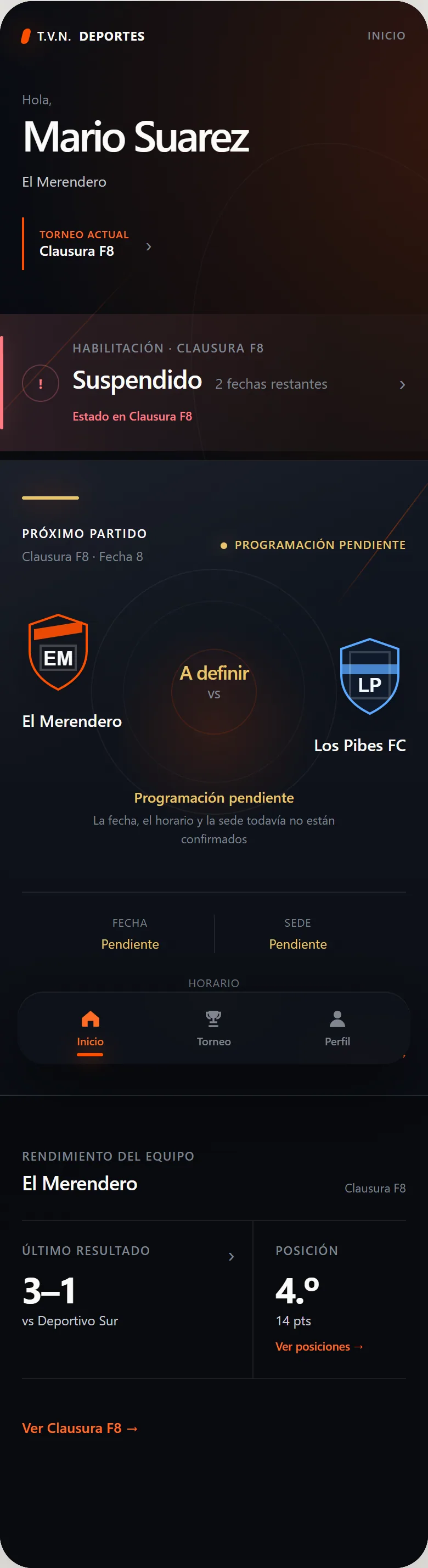
Tournament-specific suspension gains priority without displacing Match and Team context.
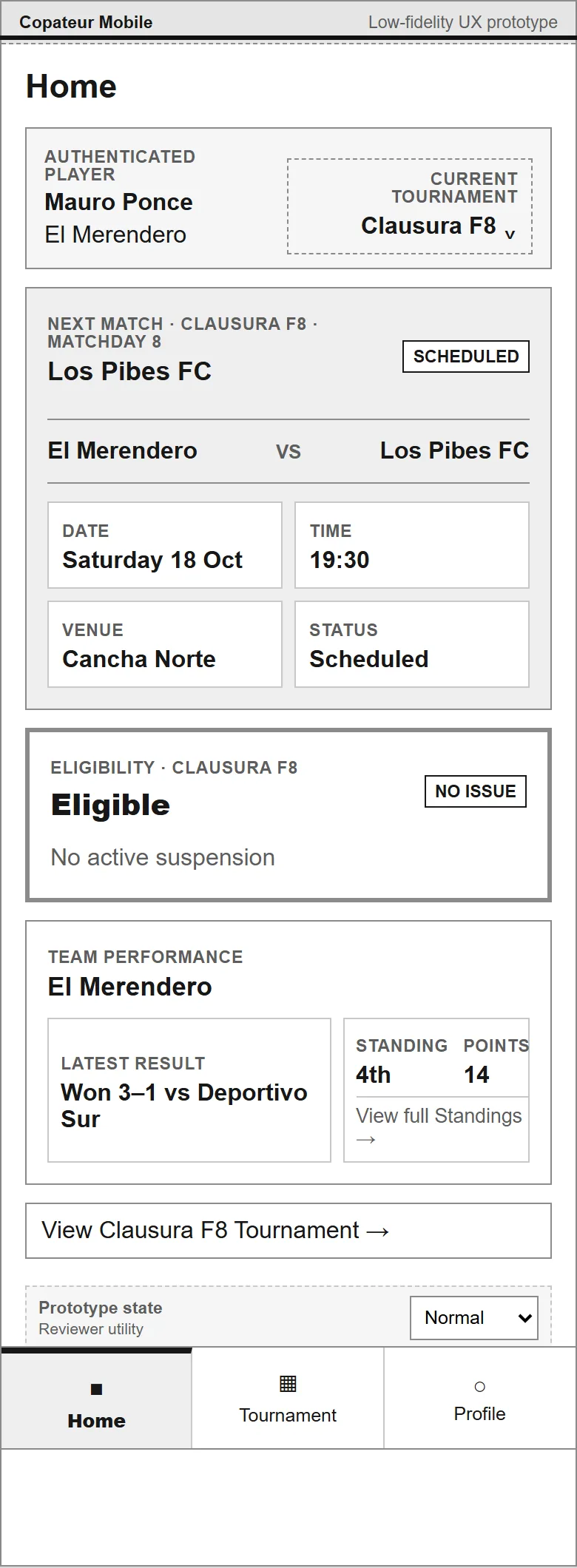
10 / Interactive low-fi
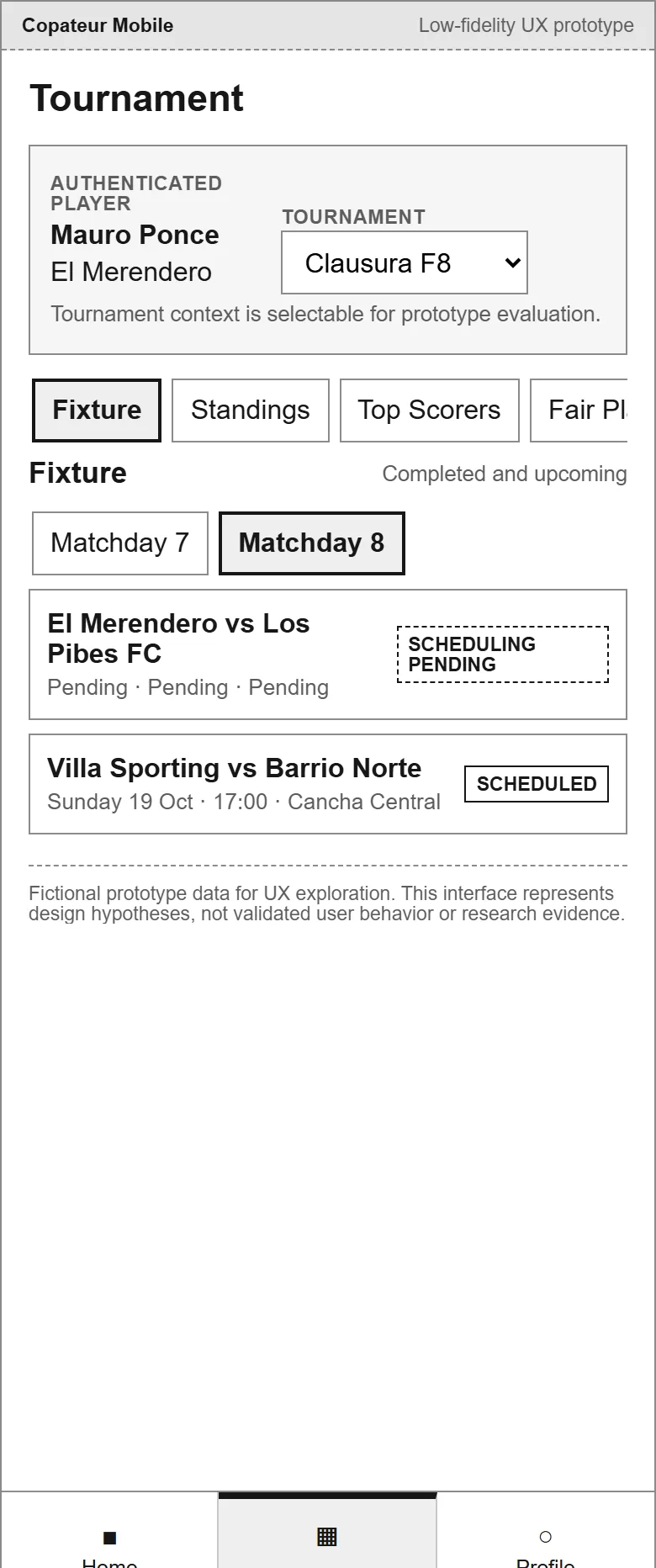
A coded low-fi made navigation, responsive behavior, and edge cases tangible before visual polish.
11 / Design iteration
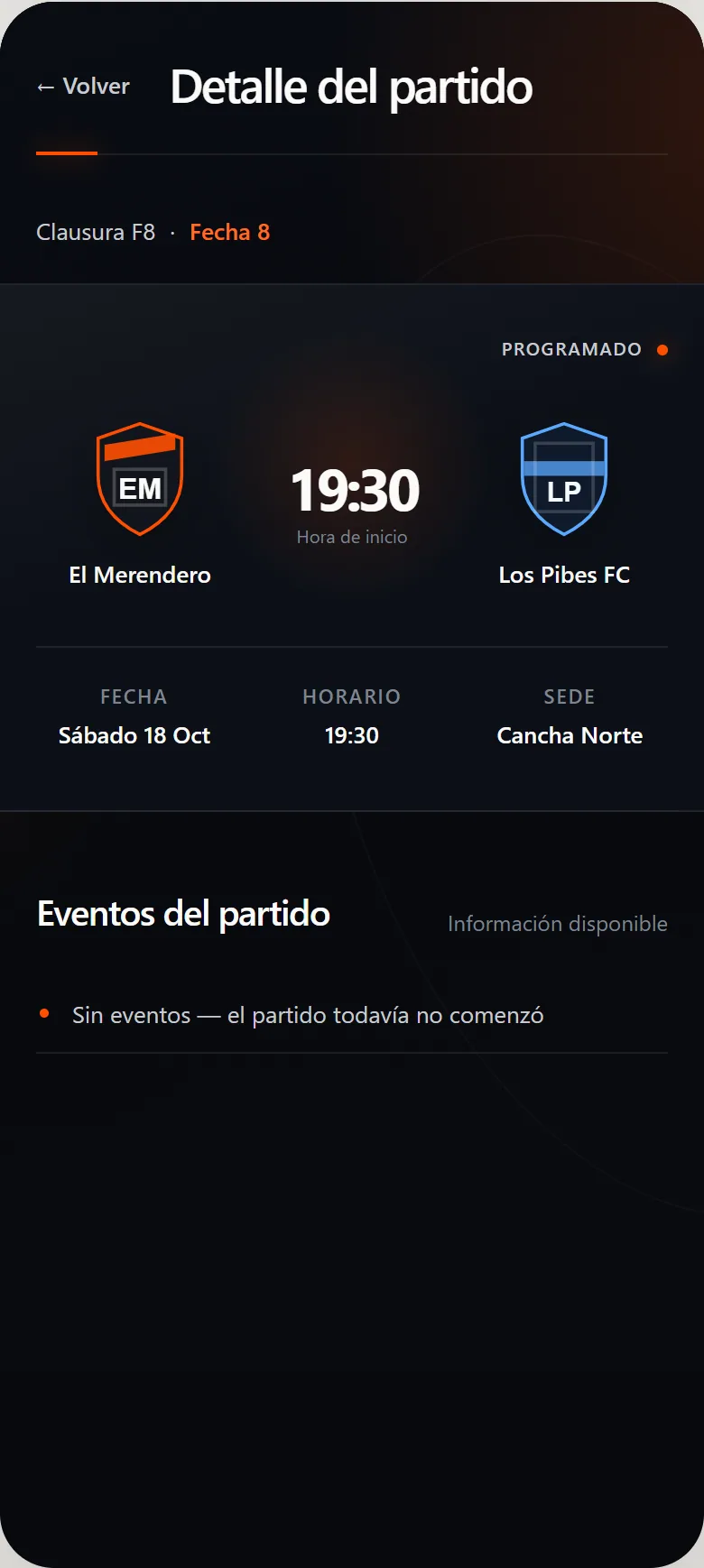
Design critique compared hierarchy, energy, typography, and product fit.
Direction 1
Established the dark foundation, token system, and product structure. Its denser containers and heavier type made the experience feel more rigid.
Direction 2
More contemporary and distinctive: stronger editorial hierarchy, fewer cards, restrained type weights, greater brand energy, and a more memorable Match Hero.
12 / Design system
Semantic tokens and repeatable patterns keep the experience consistent without turning every datum into a card.
Color roles
Type weight strategy
Spacing
Radius
Elevation
App Header·Tournament Context·Match Hero·Team Badge·Eligibility Status·Suspended Status·Team Performance·Stat with Icon·Section Navigation·Bottom Navigation
13 / Final experience
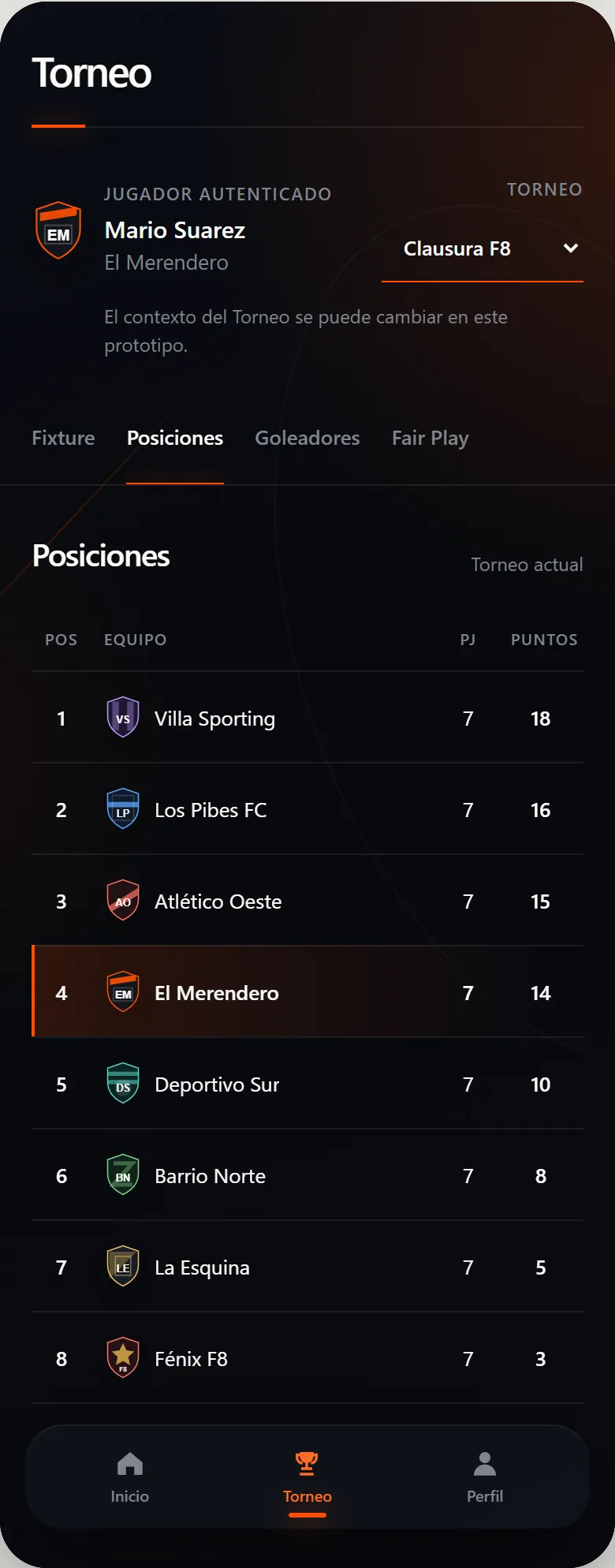
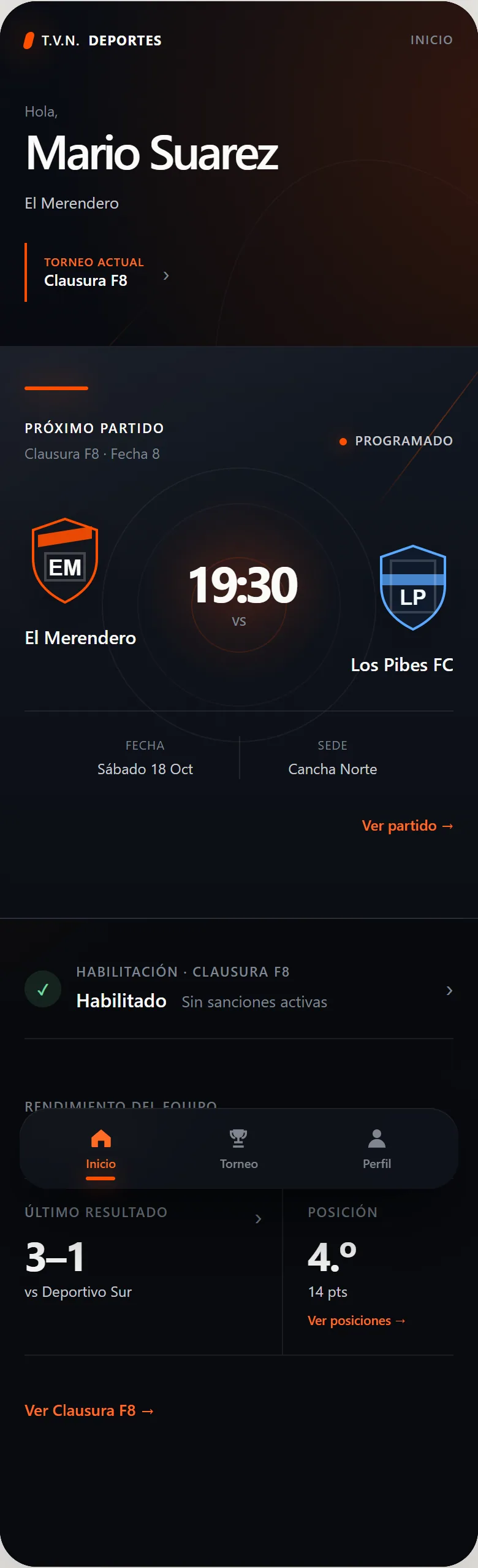
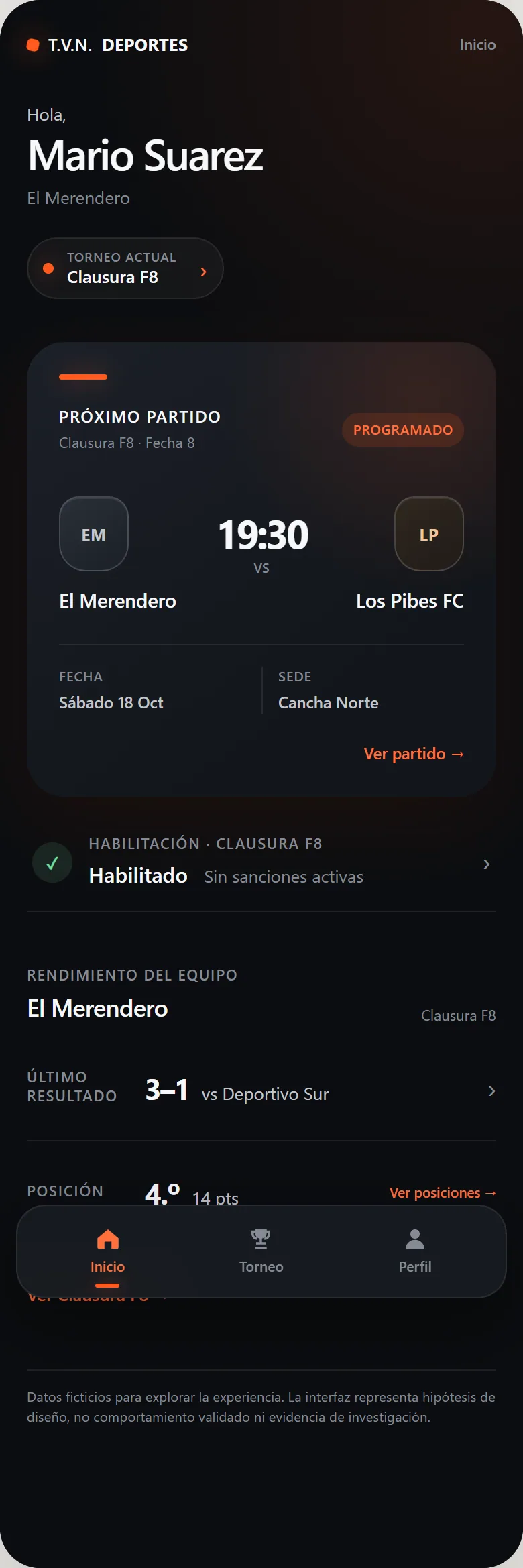
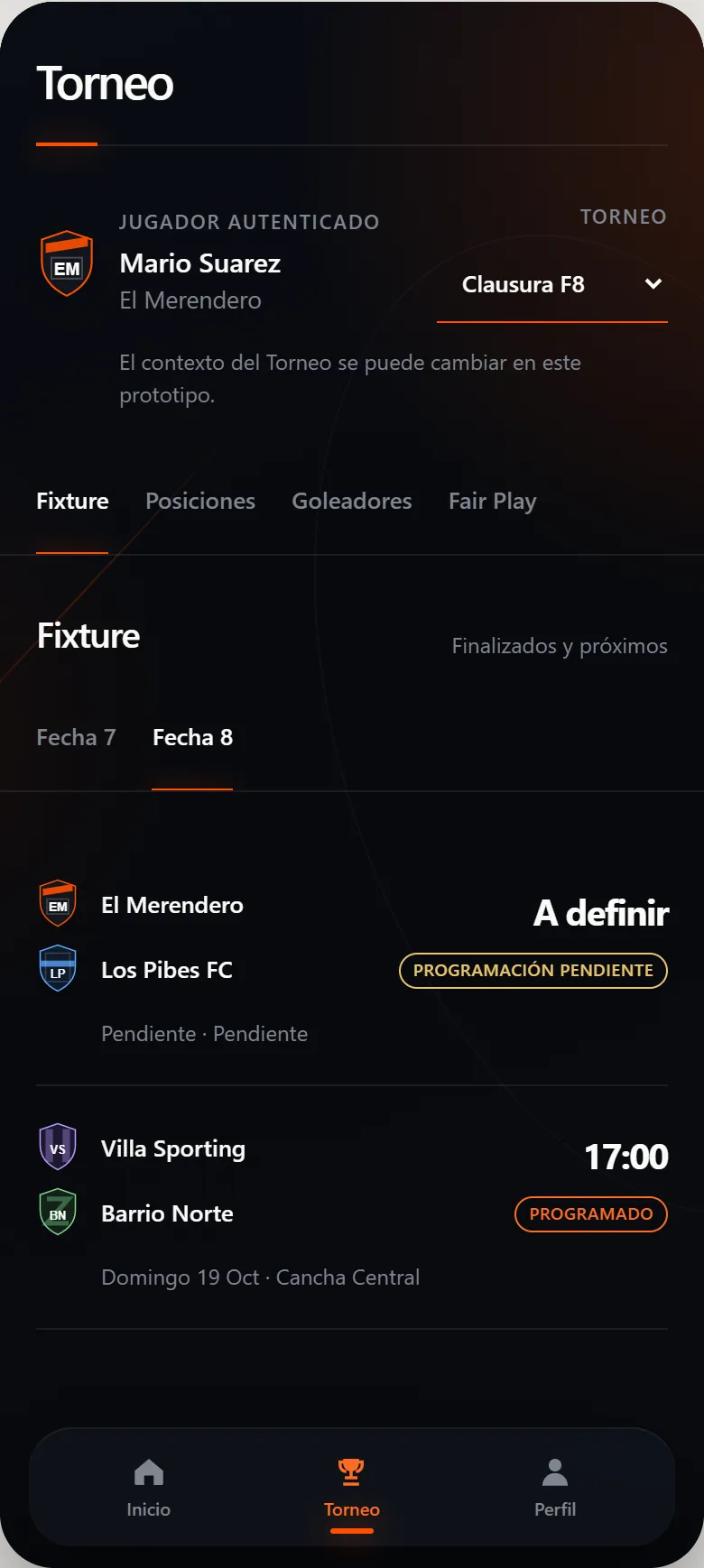
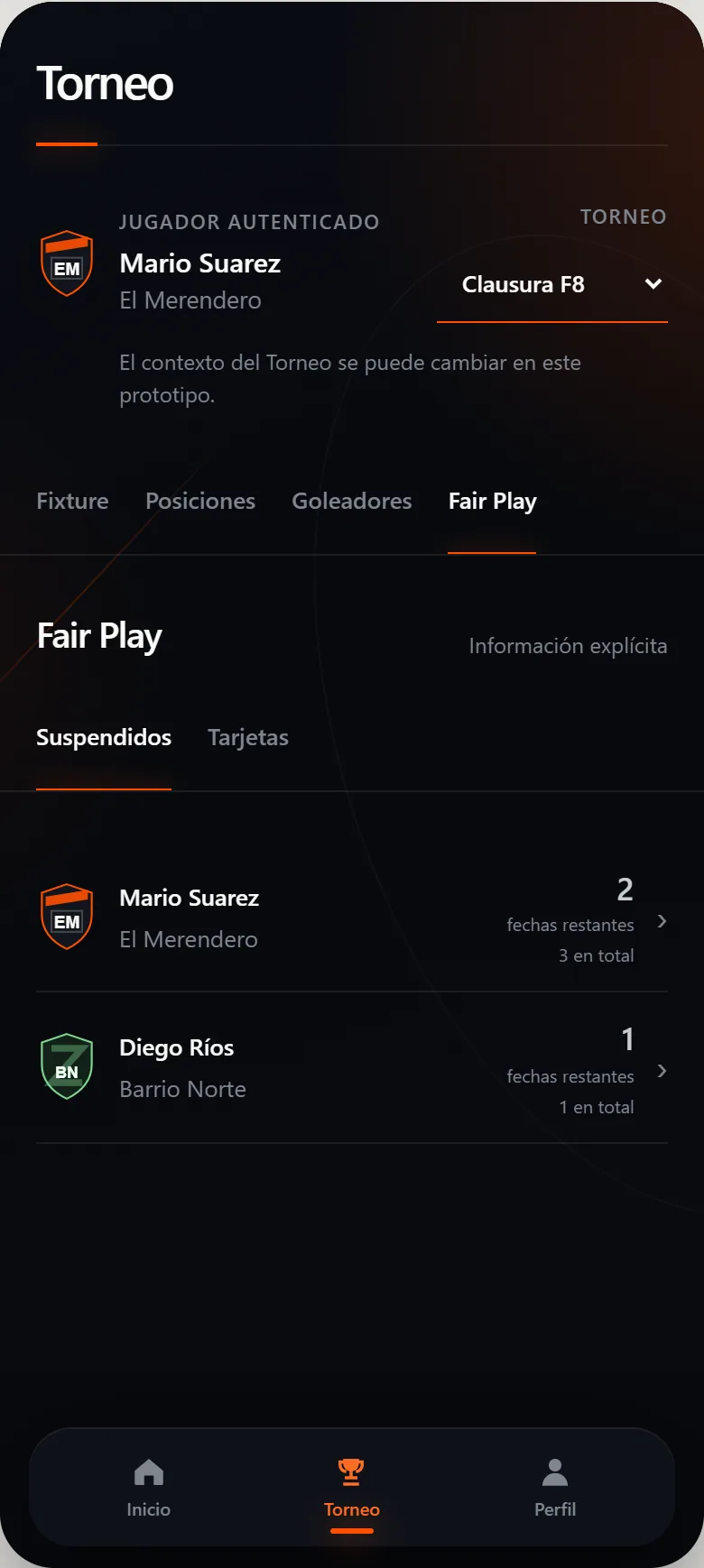
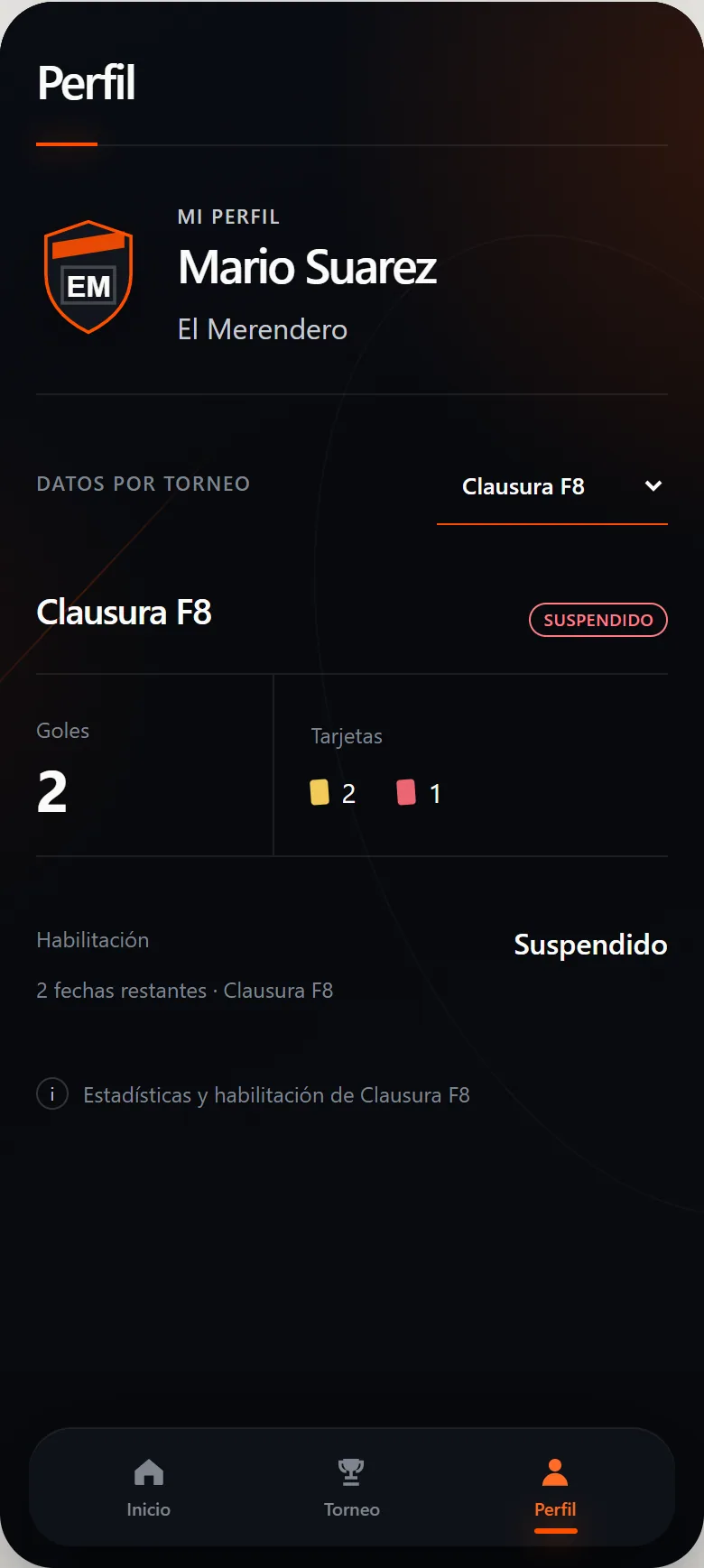
Electric Editorial Sports brings Spanish LATAM language, Team identity, explicit states, and Match-first hierarchy into one coherent experience.
Selected outcome · Electric Editorial Sports
14 / State design
Status language, hierarchy, and supporting detail work together so essential football states remain explicit.
Pending
Information is known to be unresolved—for example, a confirmed Match with venue still pending.
Unavailable
The product says “No disponible” rather than inventing or silently hiding information.
15 / Developer handoff
The handoff captures state behavior, data dependencies, interactions, accessibility, responsive constraints, and the domain rules implementation must preserve.
Component states, navigation relationships, Tournament switching, and back-context preservation.
Requirements by screen, Tournament-specific Player attributes, and pending versus unavailable values.
Responsive requirements and accessibility basics. CSS tokens can map into React Native, iOS, or equivalent production themes.
Final coded experience
Navigate the final mobile experience and explore the key Player flows.
Open prototype16 / Reflection
The workflow shortened the path from a question to a documented decision, interactive artifact, and implementation-ready system.